


Choosing the right notice board affects both functionality and longevity. Corporate offices need boards that handle frequent updates without showing wear. Retail spaces require visibility and durability. Outdoor locations demand weather resistance and security features. Understanding the differences between cork, glass, metal, and other options helps you match boards to your specific requirements—whether that’s a lockable unit for confidential information or a stainless steel frame for harsh environments.
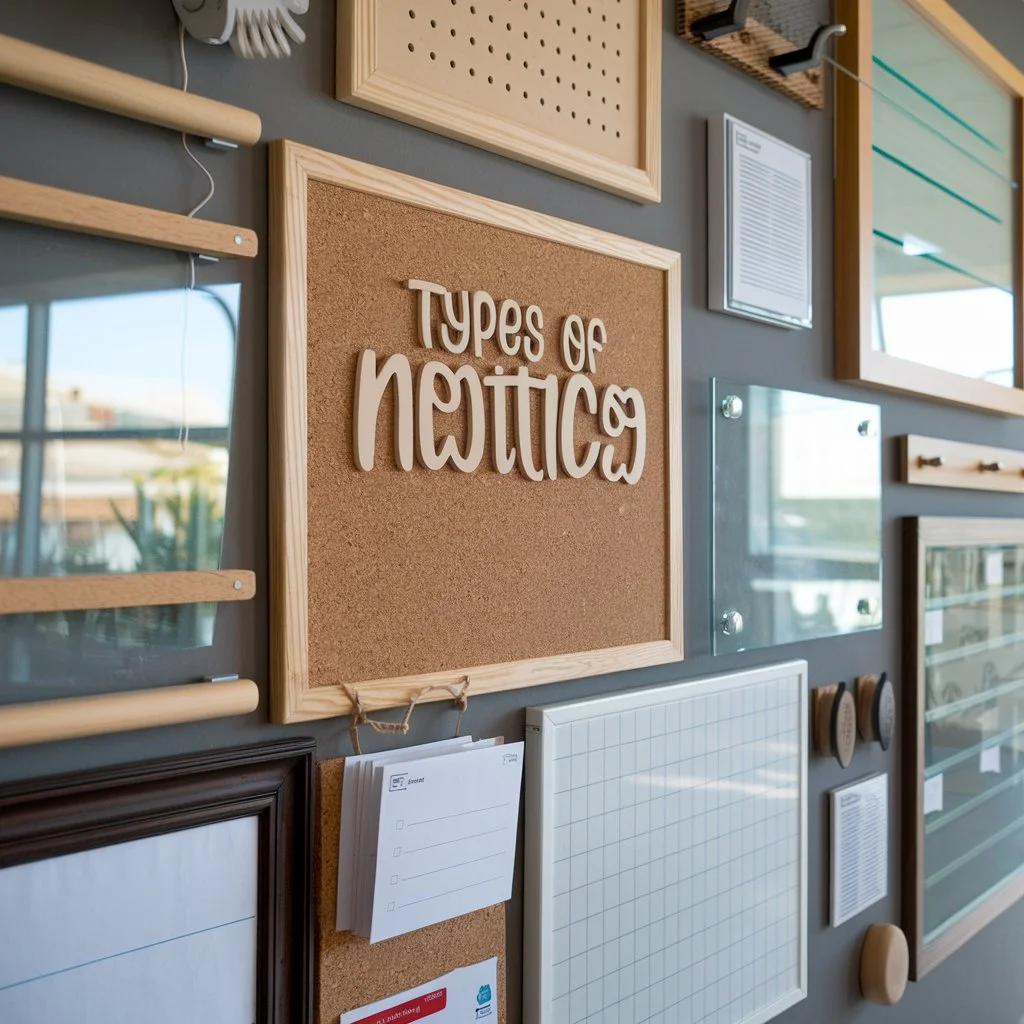
What are the Different Types of Notice Boards?
Cork Notice Boards
Cork notice boards use natural cork bark that accepts pins repeatedly. The cellular structure allows pins to enter easily, whilst partially closing the holes after removal. This self-healing property makes cork the traditional choice for pinned notices.
Quality varies significantly by thickness and density. Budget boards use 2-3mm cork over hardboard, compressing quickly and losing pin-holding ability. Quality boards use 5mm or thicker cork that maintains performance through years of use. Dense cork provides better pin retention than soft cork, which feels spongy and doesn’t hold firmly.
Aluminium frames offer the most professional appearance and better durability than wood or plastic alternatives. The frame protects board edges from damage in high-traffic areas. You can replace cork surfaces without replacing frames, extending the total lifespan substantially.
Magnetic Whiteboards
Magnetic whiteboards combine writing and document display in one surface. You can write with dry-wipe markers and attach documents using magnets. This dual capability makes them popular in meeting rooms, project spaces, and teaching environments.
The surface uses either porcelain enamel over steel or melamine coating. Porcelain enamel resists staining and ghosting far better than melamine. Markers erase cleanly even after weeks on the surface. Melamine works adequately for light use, but ghosts within months if you repeatedly write in the same spots. Magnetic strength varies based on steel backing thickness—thicker steel provides a stronger hold.
Even quality boards need proper cleaning with whiteboard cleaners to prevent marker residue buildup. General surface cleaners can damage the writing surface. Never use abrasive cleaners or pads—these scratch even porcelain surfaces.
Glass Notice Boards
Glass notice boards use toughened safety glass that creates a premium appearance suiting modern office design, executive areas, and client-facing spaces. The non-porous glass surface resists staining completely and wipes clean with minimal effort.
Most use 4-6mm toughened glass mounted on aluminium backing. You write on them with special liquid chalk markers or glass board markers. Standard magnets don’t work unless the backing includes steel, which some premium versions provide. The glass doesn’t absorb anything, so marker ink sits on top and wipes off cleanly even after extended periods.
The smooth, reflective surface can produce glare in bright office lighting. Position carefully to avoid windows or overhead lights reflecting directly into viewing angles. Frame quality determines overall lifespan—cheap frames corrode or loosen whilst the glass itself remains perfect.
Aluminium Frame Notice Boards
Aluminium frame notice boards describe the mounting structure holding cork, fabric, or a combination of surfaces. The aluminium frame provides a professional finish suiting corporate offices, reception areas, and public spaces.
Quality frames use anodised or powder-coated aluminium, resisting corrosion. Corner joints should be welded or mechanically secured—cheap frames use simple mitred corners that separate under stress. The frame protects board edges from damage whilst adding minimal cost compared to basic cork boards.
These frames often include features like sliding doors for security, locks preventing tampering, and proper mounting systems. The surface material inside needs replacing eventually, but the frame itself lasts decades with quality construction.
Lockable Notice Boards
Lockable notice boards protect displayed information from tampering or theft through glazed doors—either acrylic or glass—over cork, fabric, or whiteboard surfaces. The door locks with a simple key lock, preventing unauthorised access.
This doesn’t provide high security (someone determined can break glazing), but it prevents casual interference and signals that the content is official. The lock mechanism typically outlasts the display surface. Outdoor lockable boards require weatherproof construction with rubber or brush seals around door edges to prevent moisture ingress.
Fire-Rated Notice Boards
Fire-rated notice boards meet British Standards for fire safety in commercial buildings. These boards use materials that resist flame spread, crucial in public buildings, schools, and commercial properties where fire regulations apply.
“Fire-rated notice boards use certified materials designed to reduce flame spread and smoke. Choose boards supplied with recognised UK fire certification (often specified using Euroclass ratings), especially for public buildings, corridors, and escape routes.”
Fire safety certificates should accompany boards, documenting compliance. These certificates matter during building inspections and insurance assessments. The practical difference in day-to-day use is minimal—fire-rated boards look and function like standard versions, but use different core materials you can’t see.
Outdoor Notice Boards
Outdoor notice boards withstand weather exposure whilst maintaining legibility and accessibility. Construction differs fundamentally from indoor versions through weatherproof materials, sealed designs, and features addressing rain penetration, UV fading, and temperature variations.
Quality outdoor boards use aluminium or stainless steel frames that won’t rust. The glazed door—typically polycarbonate for impact resistance—must seal properly against the frame. Rubber gaskets provide this seal; cheap boards use inadequate seals that fail within months.
External boards often include sloped tops that shed water rather than allowing pooling. Lock mechanisms must resist corrosion—stainless steel locks suit coastal or industrial environments. Polycarbonate glazing resists impact better than glass but scratches more easily. UV-resistant materials prevent backing surfaces and posted notices from fading rapidly in sunlight.
Fabric Notice Boards
Fabric-covered notice boards use textile-wrapped surfaces over firm backing. The fabric provides a pin-friendly surface like cork but offers different aesthetic options through colour and texture choices, particularly suiting corporate environments wanting to match office colour schemes.
The fabric—typically loop nylon or felt—accepts pins readily. Some fabrics provide acoustic absorption benefits, reducing noise in open-plan offices. The fabric won’t self-heal like cork, so pin holes remain visible, though less obvious than on cork due to the textile nature.
Notice Board Materials Explained
Stainless Steel Notice Boards
Stainless steel-faced boards can be supplied with a steel backing to allow magnets, while keeping a corrosion-resistant front surface. The smooth surface wipes clean easily and doesn’t harbour bacteria.
Grade 304 suffices for most indoor applications with good corrosion resistance. Grade 316 suits marine environments or chemical exposure, offering superior resistance to chlorides and acids. The surface can be brushed (hiding minor scratches), polished (creating a reflective finish), or bead-blasted (providing a consistent, non-reflective appearance).
Metal Notice Boards
Metal notice boards generally refer to aluminium-framed or full-aluminium construction. Aluminium provides an excellent balance of durability, corrosion resistance, and cost-effectiveness for both indoor and outdoor applications.
Powder-coated aluminium resists corrosion far better than paint finishes. The powder coating fuses to the metal surface during curing, creating a hard, durable finish that resists chipping and scratching. Anodised aluminium offers even better durability—colour penetrates the metal surface—but costs more with more limited colour options.
Aluminium weighs about one-third of equivalent steel, making wall mounting easier and reducing stress on fixings. This matters particularly for large boards or locations where wall strength limits heavy installations.
Glass Materials
Glass notice boards use toughened safety glass (tempered glass) that shatters into small, relatively safe granules if broken rather than producing dangerous shards. The glass undergoes heat treatment, creating internal stresses, making it 4-5 times stronger than standard glass.
Glass boards come in clear or frosted finishes. Clear shows whatever’s behind it. Frosted or back-painted glass creates an opaque surface, working better for display. The glass itself essentially lasts forever—it doesn’t degrade, scratch easily, or absorb anything.
Fabric-Covered Surfaces
Loop nylon fabric is particularly popular—the looped construction accepts pins readily whilst providing a clean, uniform appearance. Felt offers a softer texture but shows pin holes more prominently. Both materials come in wide colour ranges, allowing boards to match office schemes.
The fabric surface provides some acoustic absorption, reducing sound reflection in open-plan offices. This acoustic benefit is modest but contributes to overall sound management—fabric yellows with UV exposure faster than cork. The textile also accumulates dust and shows dirt more readily than hard surfaces. Vacuum occasionally using upholstery attachments. Avoid water cleaning, which can stain or damage fabric.
Notice Board Comparison
| Type | Durability | Maintenance | Best For | Indoor/Outdoor |
| Cork | Medium (8-10 years) | Very Low | General office, communal areas, informal updates | Indoor only |
| Magnetic Whiteboard | High (10-15 years porcelain) | Medium | Meeting rooms, project spaces, training rooms | Indoor only |
| Glass | Very High (15+ years) | Low | Executive offices, modern spaces, client areas | Indoor only |
| Aluminium Frame Cork | High (frame 15-20 years) | Low | Professional offices, reception areas | Both |
| Stainless Steel | Very High (20+ years) | Very Low | Coastal, industrial, hygiene-critical areas | Both |
| Lockable | Varies by construction | Low-Medium | Confidential info, legal notices, secure areas | Both |
| Fire-Rated | High (10-15 years) | Low | Public buildings, escape routes, compliance | Indoor mainly |
| Outdoor | High (10-15 years quality) | Medium | External notices, car parks, public areas | Outdoor only |
| Fabric | Medium (5-7 years) | Low-Medium | Offices needing colour, acoustic benefits | Indoor only |
Choosing the Right Notice Board
By Environment
Corporate offices typically favour glass or aluminium-framed cork boards for a professional appearance. Glass suits executive areas and modern offices. Aluminium-framed cork works well for general office areas needing frequent updates. Retail environments need visibility and durability. Lockable outdoor boards work for external promotions.
Schools and educational settings require durability and fire safety compliance. Fire-rated cork boards suit classrooms and corridors. Lockable boards protect examination timetables and confidential student information. Industrial and warehouse environments need robust construction. Metal-framed boards resist damage. Stainless steel suits food preparation areas for hygiene compliance.
By Security Requirements
Open-access information suits standard cork or whiteboard configurations. Anyone can update content, appropriate for team updates, informal communication, or general office information. Lockable boards protect content from unauthorised changes—use these for legal notices, rotas, confidential information, or any content where tampering creates problems. High-security environments might need features beyond simple locks.
By Update Frequency
Frequent updates favour materials tolerating repeated changes. Cork handles constant pinning well. Magnetic whiteboards suit daily changes using markers. Glass boards work for regular marker updates, but don’t accept pins. Static displays changing weekly or monthly can use any type.
Very frequent updates—multiple times daily—might favour whiteboards over pinning materials. Constantly adding and removing pinned notices becomes tedious. Whiteboards allow quick erasure and rewriting.
By Budget Considerations
Consider lifecycle costs rather than just initial price. A premium glass board lasting 20 years costs less annually than budget cork boards, needing replacement every few years. Quality construction provides better service over time. Cheap boards showing wear within months create frustration and premature replacement costs.

Frequently Asked Questions
Can I install notice boards on plasterboard walls?
Yes, but you need proper fixings. Plasterboard alone won’t support heavy boards. Use cavity fixings (spring toggles or metal cavity anchors) that spread load across the plasterboard. For heavy boards, locate studs behind plasterboard and fix directly into timber. Alternatively, install a mounting board (plywood or similar) fixed to studs, then mount the notice board to this. Lightweight acrylic-fronted boards work fine with cavity fixings. Heavy glass or multiple cork boards need stud fixing.
Do fire-rated boards need replacing after specific periods?
No, fire-rated boards don’t have expiry dates. The fire rating applies to materials used, not time-limited certification. The boards remain compliant indefinitely unless damaged. However, keep the original fire certification documentation for building inspections. If you replace cork or fabric surfaces inside fire-rated frames, ensure replacement materials also meet fire standards. Using non-compliant materials inside fire-rated frames invalidates the fire rating.
Can I use outdoor notice boards indoors?
Yes, outdoor boards work indoors perfectly well. They’re overspecified for indoor use, meaning you’re paying for features you don’t need—weatherproof seals, corrosion-resistant materials, impact-resistant glazing. However, if you already have outdoor boards or got them at a reasonable price, they’ll work fine indoors. The reverse doesn’t work—indoor boards fail quickly outdoors due to moisture penetration and inadequate weather resistance.
How do I remove permanent markers from whiteboards?
Write over the permanent marker with a dry-wipe marker, then erase immediately. The dry-wipe marker’s solvents dissolve permanent marker ink. Alternatively, use methylated spirits or isopropyl alcohol on a cloth. Rub gently—don’t scrub aggressively. Commercial whiteboard cleaners also work. For stubborn marks on porcelain surfaces, try a non-abrasive cream cleaner. Melamine surfaces are more complex to clean—permanent markers often leave ghost marks.
Do lockable notice boards come with universal keys?
No. Each board typically uses unique keys, though manufacturers often use the same lock types across their range. If you order multiple boards from the same supplier, request that they be keyed alike—all boards open with the same key. This simplifies key management. Some manufacturers offer master key systems where each board has an individual key, but a master key opens all boards. Specify this requirement when ordering if you need it.
Can fabric notice boards be steam cleaned?
No, avoid steam cleaning fabric boards. The moisture penetrates fabric and backing board, potentially causing warping, mould growth, or fabric delamination—vacuum regularly with the upholstery attachment to remove dust. For stains, use dry cleaning methods or specialist fabric cleaners applied sparingly. Test any cleaner on an inconspicuous area first. For heavily soiled fabric, replacement is often more practical than attempting deep cleaning.
What spacing do I need between multiple notice boards on a wall?
Leave at least 100-150mm between boards for aesthetic balance and practical access. This spacing allows you to reach edges comfortably when pinning notices. For lockable boards, ensure door swing doesn’t interfere with adjacent boards—typically needs 200mm+ clearance. Consider the viewing distance too. Boards mounted too close together can look cluttered. For formal office settings, equal spacing creates a professional appearance.
Are there left-handed and right-handed lockable boards?
Yes, lockable boards with side-hinged doors come in left-hand or right-hand opening configurations. Specify which you need based on wall position and access. A board in a corner should open away from the corner for full access. Some manufacturers offer reversible doors fitting either side. Central-opening double doors avoid handedness issues. Check specifications when ordering to ensure doors open in the direction you need.
Can notice boards be mounted on a brick without drilling?
Not securely for permanent installation. Adhesive fixings exist, but don’t provide a reliable hold for anything beyond very lightweight temporary boards. Brick is porous and irregular, making adhesive bonding unreliable. For proper installation, drill and plug the brick, then use appropriate masonry screws or bolts—this is especially important for secure brick address plaque installation or heavier outdoor signage. If you absolutely can’t drill—rental property restrictions, historic buildings—use freestanding notice boards on legs rather than attempting wall mounting without proper fixings.
Conclusion
Selecting appropriate notice boards requires balancing durability, functionality, and the environment. Understanding material properties—cork’s self-healing nature, stainless steel’s corrosion resistance, glass’s longevity—helps match boards to specific needs. Quality construction costs more initially but provides better service over the years. Consider update frequency, security requirements, and environmental conditions when choosing. The right board serves reliably for years, whilst wrong choices create frustration and premature replacement costs.