

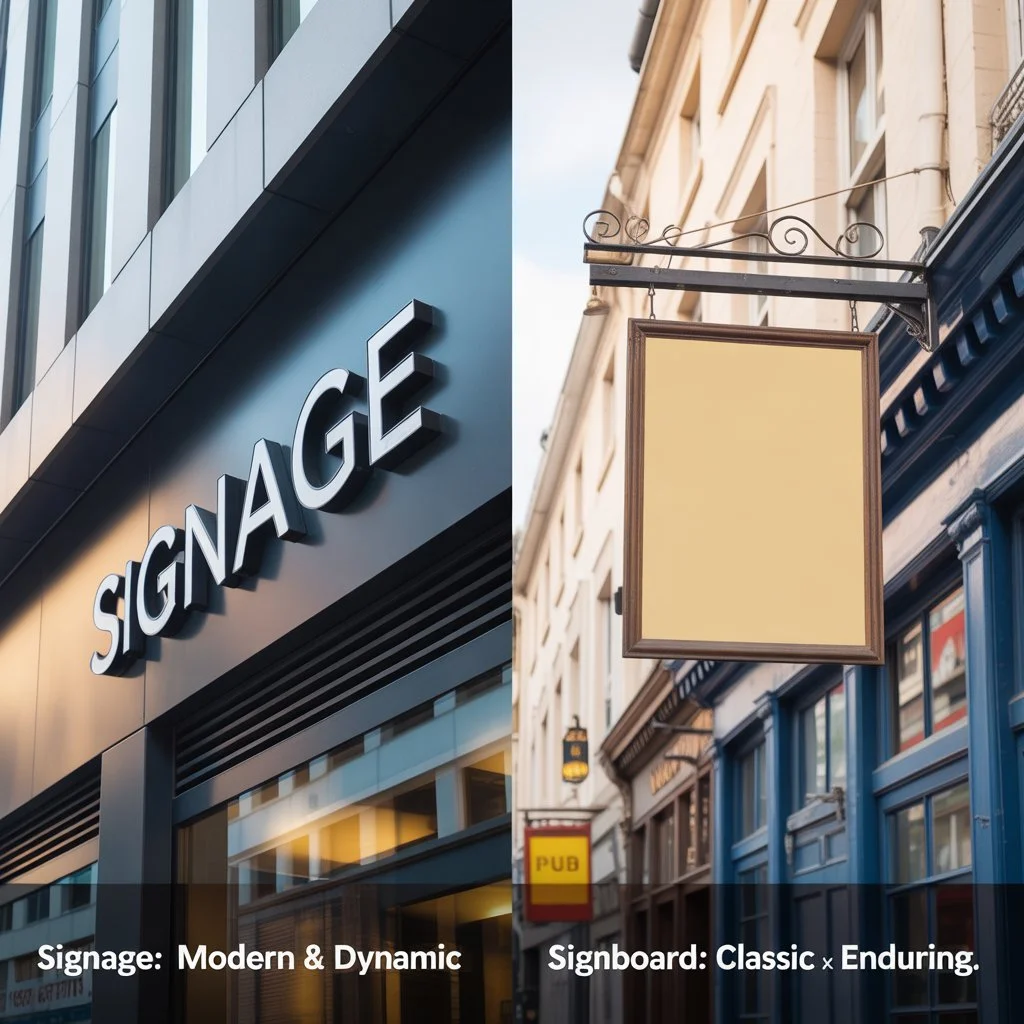
Quick Answer: Signage refers to a complete system of visual communication, think wayfinding signs in airports, directional markers in hospitals, or branded displays across a retail chain. A signboard, however, is typically a single, standalone board used for advertising or announcements, like a promotional board outside a shop or a notice board in a community centre. The key distinction lies in purpose and scope: signage guides and informs within a space, whilst signboards primarily advertise or announce.
If you’ve ever searched for “signage” and “signboard” expecting to find interchangeable terms, you’re not alone. These words appear similar, yet they represent quite different concepts in the world of visual communication. Getting this distinction right matters, whether you’re briefing a designer, planning a property fitout, or simply trying to communicate what you need for your business signage needs.
The confusion stems from overlapping usage in everyday language. People say “signage board” when they might mean either term. But in professional contexts like design, architecture, and retail planning, the difference becomes important. Using the wrong term can lead to miscommunication, incorrect quotes, or solutions that don’t match your actual requirements.
What is Signage?
Signage is a coordinated system of signs working together to communicate consistently across a space or brand. It’s not just one sign, it’s the entire visual language that helps people navigate, understand, and interact with an environment.
Think of a shopping centre. The directional signs pointing to various stores, the restroom markers, the car park level indicators, the emergency exit signs, and the store identification panels all form part of the signage system. They share design elements: consistent fonts, colour schemes, materials, and mounting methods. This consistency creates clarity and reinforces brand identity.
Types of Signage
Wayfinding signage helps people navigate complex spaces. Hospitals, universities, airports, and large office buildings rely heavily on this. The signs work as a family, each one providing information that connects to the next, creating a logical path through the environment. Learn more about how wayfinding systems create clear pathways in challenging environments.
Regulatory signage communicates rules and safety information. Fire exit signs, prohibition notices, health and safety warnings, and accessibility information fall into this category. They often follow legal standards and must meet specific visibility and placement requirements.
Identification signage marks locations, rooms, departments, or facilities. Reception signs, room numbers, building directories, and department markers help people confirm they’re in the right place.
Digital signage encompasses electronic displays showing dynamic content. Information screens in transport hubs, menu boards in restaurants, or promotional displays in retail environments offer updateability and time-sensitive information. To understand the full spectrum of sign options for commercial spaces, businesses can explore solutions tailored to their specific needs.
Common Uses of Signage
Retail environments use signage systems to create consistent customer experiences across multiple locations. Every branch maintains visual coherence through standardised signage, from the fascia to the internal wayfinding.
Corporate offices deploy signage to reflect brand values whilst helping staff and visitors navigate efficiently. From reception areas to meeting rooms, internal signage displays contribute to the overall aesthetic and functionality of the workplace environment.
Healthcare facilities require particularly robust signage systems. Patients and visitors often arrive stressed or unfamiliar with the building layout. Clear, logical signage reduces confusion and helps people reach appointments on time.
What is a Signboard?
A signboard is a single, self-contained board displaying information, typically for advertising or public announcements. Unlike signage systems, signboards function independently, they don’t need to coordinate with other signs to fulfil their purpose.
The classic example is a promotional board outside a shop advertising a sale or a new product. Estate agent boards, roadside advertising boards, and construction site notice boards all fit this definition. They’re usually temporary or semi-permanent, designed to attract attention and convey a specific message to passersby.
Types of Signboards
Promotional signboards advertise sales, events, or special offers. Retailers place these at entrances or in windows to drive foot traffic and communicate time-sensitive messages.
Information signboards display notices, announcements, or schedules. Community centres, schools, and local councils use these to share information with the public. Unlike digital alternatives, they work without power and remain visible around the clock.
Directional signboards point people towards locations with a single-point direction. A simple “Car Park →” board serves this function without being part of a larger system.
Common Uses of Signboards
Small businesses rely on signboards for cost-effective local advertising. An A-board on the pavement announcing today’s lunch special costs little but can significantly increase walk-in trade.
Events and temporary installations use signboards because they’re portable and don’t require permanent fixings. Festival directions, conference room indicators, or pop-up shop branding can all be achieved with signboards that pack away after the event.
Construction and development sites use signboards to display planning permissions, contractor information, and safety notices, serving both legal requirements and public information needs.

Key Differences Between Signage and Signboard
| Aspect | Signage | Signboard |
| Scope | System of multiple signs working together | Single, standalone board |
| Purpose | Navigation, identification, and consistent communication | Advertising, announcements, or single-point information |
| Design approach | Coordinated family with consistent visual language | Individual piece designed for immediate impact |
| Permanence | Usually permanent or long-term installation | Often temporary or semi-permanent |
| Cost structure | Higher initial investment, lower per-sign cost at scale | Lower individual cost |
| Flexibility | Changes require maintaining system consistency | Each board can change independently |
| Primary users | Large organisations, multi-site businesses, complex facilities | Small businesses, events, temporary promotions |
Purpose and Function
Signage exists to create understanding across an environment. It reduces confusion, reinforces brand identity, and helps people complete tasks efficiently. The signs must work as a cohesive unit, if one sign uses different terminology or styling, it breaks the system’s effectiveness.
Signboards aim to capture attention and communicate a specific message quickly. A shopfront signboard promoting a weekend sale has done its job if people notice and remember the offer.
Design and Materials
Signage systems typically use premium, durable materials because they represent long-term investments. Aluminium composite panels, acrylic, stainless steel, and architectural-grade vinyl feature commonly. At Magenta Signs Ltd, we often recommend materials based on environment and expected lifespan, ensuring your investment delivers value over time.
Signage systems typically use premium, durable materials because they represent long-term investments. Aluminium composite panels, acrylic, stainless steel, and architectural-grade vinyl feature commonly. For businesses operating beyond daylight hours, backlit and LED sign options ensure visibility and impact around the clock. At Magenta Signs Ltd, we often recommend materials based on environment and expected lifespan, ensuring your investment delivers value over time.
Signboards often use more economical materials suited to their temporary nature. Foamex, Correx, and printed vinyl on lightweight substrates work well, with a focus on cost-effectiveness and ease of replacement.
Placement and Context
Signage placement follows careful planning. Designers consider sightlines, walking speeds, decision points, and accessibility standards. Each sign’s location relates to others in the system, creating a logical information hierarchy.
Signboards get placed wherever they’ll achieve maximum visibility for their specific message. A promotional board goes where footfall is highest, serving the individual board’s purpose rather than fitting into a larger scheme.
When to Use Signage vs Signboard
Choose signage when you need consistent communication across multiple locations or throughout a complex space. If you’re opening several branches, refurbishing an office, or managing a facility where navigation matters, a proper signage system makes sense. The upfront investment pays off through reduced confusion, stronger brand presence, and lower long-term costs per sign.
Signboards work better for specific, often time-limited communication needs. Promoting a sale, announcing an event, or displaying information that changes regularly suits signboards. The flexibility and lower individual cost make them practical for businesses without multi-site requirements.
Budget plays a role too. Signage systems require larger initial outlays but cost less per unit at scale. Signboards need minimal upfront spend but won’t benefit from economies of scale if you eventually need multiple signs with consistent branding.

Examples in Real-World Applications
Retail chains use signage systems extensively. Walk into any branch of a major supermarket and, you’ll see the same visual language: aisle markers with consistent typography, department signs using brand colours, and checkout indicators following standard formats.
Independent shops often use signboards effectively. A café might have an A-board on the pavement announcing today’s specials, a window board promoting a loyalty card, and a notice board inside for community announcements. When combined with well-designed creative storefront displays, these elements create a cohesive visual identity that attracts customers.
Business parks demonstrate both concepts. The overall park uses a signage system for entrance markers, building identifiers, and wayfinding. Individual tenant companies might add signboards for promotional displays or temporary notices.
Educational institutions require comprehensive signage for navigation with room numbers, department signs, and directional markers. They supplement this with signboards for event announcements, examination timetables, or student society promotions.
Frequently Asked Questions
Is a signboard a type of signage?
Technically, a signboard can be considered one element within the broader category of signage, but the terms aren’t interchangeable. When professionals discuss “signage,” they typically mean a coordinated system rather than individual boards.
Can signage be digital?
Yes. Digital signage has become increasingly common, particularly in retail, transport, and corporate environments. It’s part of a coordinated communication system, just delivered through screens rather than static materials.
What’s cheaper, signage or signboards?
Per individual unit, signboards cost less. A single promotional board might cost £50 to £200, whilst a single piece of architectural signage could run £500 to £2,000. However, if you need multiple signs with consistent branding, a properly designed signage system becomes more cost-effective through economies of scale. Please note these are estimated costs and can vary based on materials, size, complexity, and installation requirements.
How do I know which one my business needs?
Ask yourself: do you need multiple signs to work together, or a single sign for a specific purpose? Will the signs need to maintain visual consistency? Are you communicating across multiple locations or a complex space? When you’re unsure, speaking with experienced sign specialists like Magenta Signs Ltd can help clarify which solution best fits your requirements.
Can I mix signage and signboards?
Most businesses do. You might have a core signage system for permanent identification and wayfinding, supplemented by signboards for promotions and temporary communications. The key is ensuring the signboards don’t undermine the signage system’s clarity.
Do signboards need planning permission?
It depends on size, location, and local regulations. In the UK, small signboards often fall under “permitted development” and don’t need planning permission, but larger boards, illuminated signs, or boards in conservation areas typically require approval. Always check with your local planning authority before installing outdoor signboards.
Need Help Choosing the Right Solution for Your Business?
Understanding whether you need signage or signboards helps you communicate requirements clearly and achieve better results. Signage creates systems; signboards deliver messages. Both have their place, and knowing which serves your purpose makes all the difference.
If you’re still weighing up your options or want expert guidance on which approach suits your business best, Magenta Signs Ltd can help. Whether you need a comprehensive signage system for multiple locations or effective signboards for immediate impact, we’ll work with you to find the solution that matches your goals and budget. Get in touch to discuss your requirements.